



Pattern Decoded is our Monday format where we cover the most well-known patterns in technical analysis. This week we talk about Japanese candlesticks and the Evening Star.
Let’s talk about Japanese candlesticks.
The Evening Star is a three-candle reversal pattern. It signals the potential end of an uptrend. Not its certainty.
Like any candlestick pattern, it requires context, structure, and confirmation.
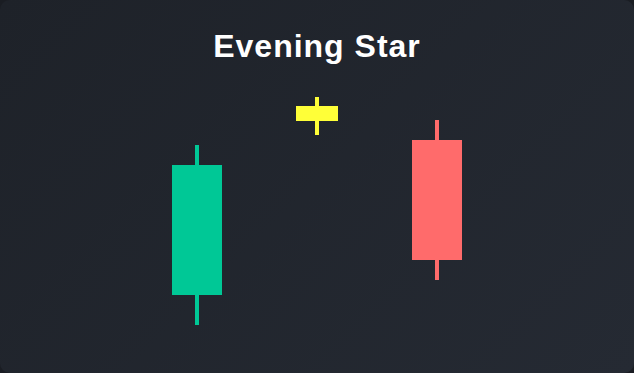
chart: Japanese Candelsticks Pattern – Evening Star
Prerequisite: Uptrend
The Evening Star is valid only in an uptrend. No uptrend, no pattern.
An uptrend is confirmed if at least one of these conditions is met:
- Higher highs and higher lows. The market is making progress to the upside.
- Price above a directional moving average. The trend filter confirms bullish bias.
- Bullish extension exceeds the prior average range. Momentum is expanding to the upside.
If none of these conditions is satisfied, the pattern is not valid.
Morphology
The pattern consists of three candles.
Candle 1: Bullish body. Body size larger than the average of recent candles. This is the trend in motion: strong, confident, directional.
Candle 2 (the Star): Small body. Positioned above the close of Candle 1. A gap is preferable but not required. The color is irrelevant. This is indecision: the market hesitates at the highs.
Candle 3: Bearish body. Closes inside the body of Candle 1, below its 50% mark. This is the reversal attempt: sellers push back with conviction.
If any of these conditions is not met, the pattern is not valid.
The Dynamics
Candle 1 shows dominant bullish pressure. The trend is strong.
Candle 2 shows loss of momentum. Bulls push higher but fail to extend. The body shrinks. Energy fades at the top.
Candle 3 shows sellers stepping in. The bearish body closes deep into Candle 1—a visual confirmation that buyers have lost control.
The high of Candle 2 identifies resistance. This level defines the risk.
Pattern Status
At the close of Candle 3, the pattern is classified as:
- Configuration present. The structure is complete.
- Signal NOT active. The trigger has not been hit.
The pattern alone is not a trading signal. It is information that requires confirmation.
Confirmation
The Evening Star signal activates only on the break of the low of Candle 3.
Before the break, the price movement is to be considered a correction, not a reversal.
Additional evidence that strengthens the signal: the Star forms at a previous resistance, at a significant moving average, or at another relevant technical level.
Failure
The pattern fails if any of the following occurs:
- Candle 3 does not close below the 50% mark of Candle 1.
- The low of Candle 3 is not broken.
- Price breaks above the high of Candle 2.
The pattern fails if price breaks above resistance.
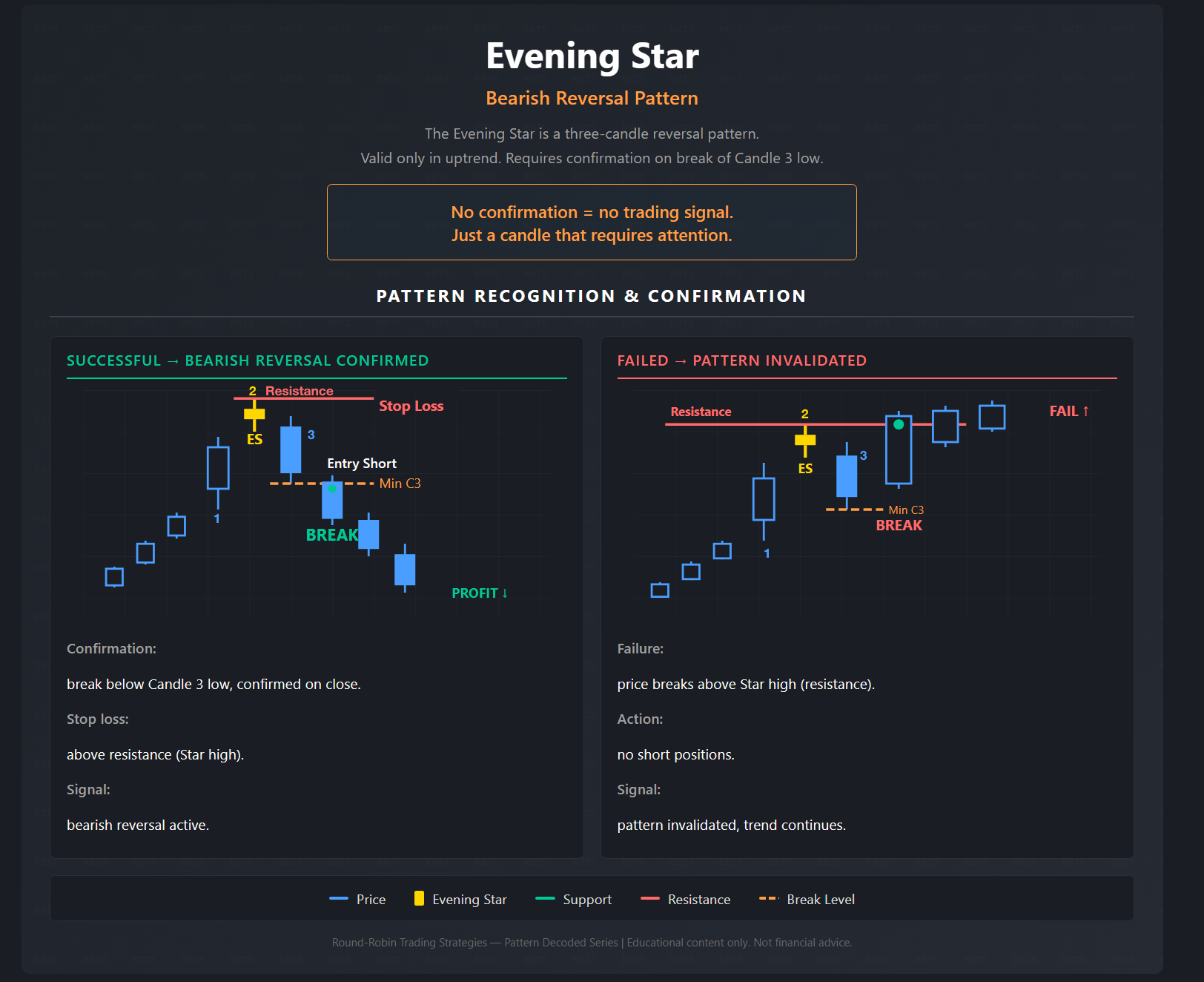
Pattern Recognition: Evening Star
Trading Implications
The high of Candle 2 identifies resistance. That level can be used for stop loss.
Caution for those holding long positions: the market has shown selling pressure at the highs. Momentum is fading.
Reversal possible, not certain. Wait for confirmation before entering short.
The Evening Star does not anticipate the reversal. It serves to:
- identify loss of momentum
- define a risk area for long positions
- wait for directional confirmation
Next time you see an Evening Star, ask yourself: is there confirmation?
Is there additional technical evidence?
If the answer is no, you don’t have a trading signal.
You have a candle that requires attention, not action.
Leave a Reply